Every day, businesses lose millions of users who abandon digital services because they can't get past onboarding. A customer downloads your app, creates an account, and then come the identity verification steps: photograph government IDs, enter multiple identification numbers, and a few other steps that take anywhere from 15 to 20 minutes. After having repeated this process across different apps and services, the friction compounds and customers drop off before they get any experience or value from your product. Today, a business' competition isn't just another company building a comparable service; it's also customers' onboarding fatigue.
This is why we're excited to announce Mono Prove, a transformative approach to identity verification as we know it. Prove is an end-to-end fast and secure identity verification service that combines three capabilities into a single platform: comprehensive identity verification, instant liveness detection, and tokenized identity data that works across the Mono ecosystem.
Prove's core innovation is identity tokenization. When a user verifies their identity through Mono Prove, that verification can be securely saved and tokenized with the user's consent, and safely reused for future verifications. If the user onboards with a neobank using Prove, they can onboard with an insurance platform, a lending service, and even with your business using the same verified identity. They don't have to resubmit documents or go through the same lengthy process all over again; they simply verify once and use it everywhere.
This fundamentally changes the economics of onboarding. For users, friction drops dramatically. For businesses, conversions happen, and acquisition costs are recouped. Within the Prove network, scale accelerates because each new verified customer makes the system more valuable for everyone else.
What's in Mono Prove and how it works
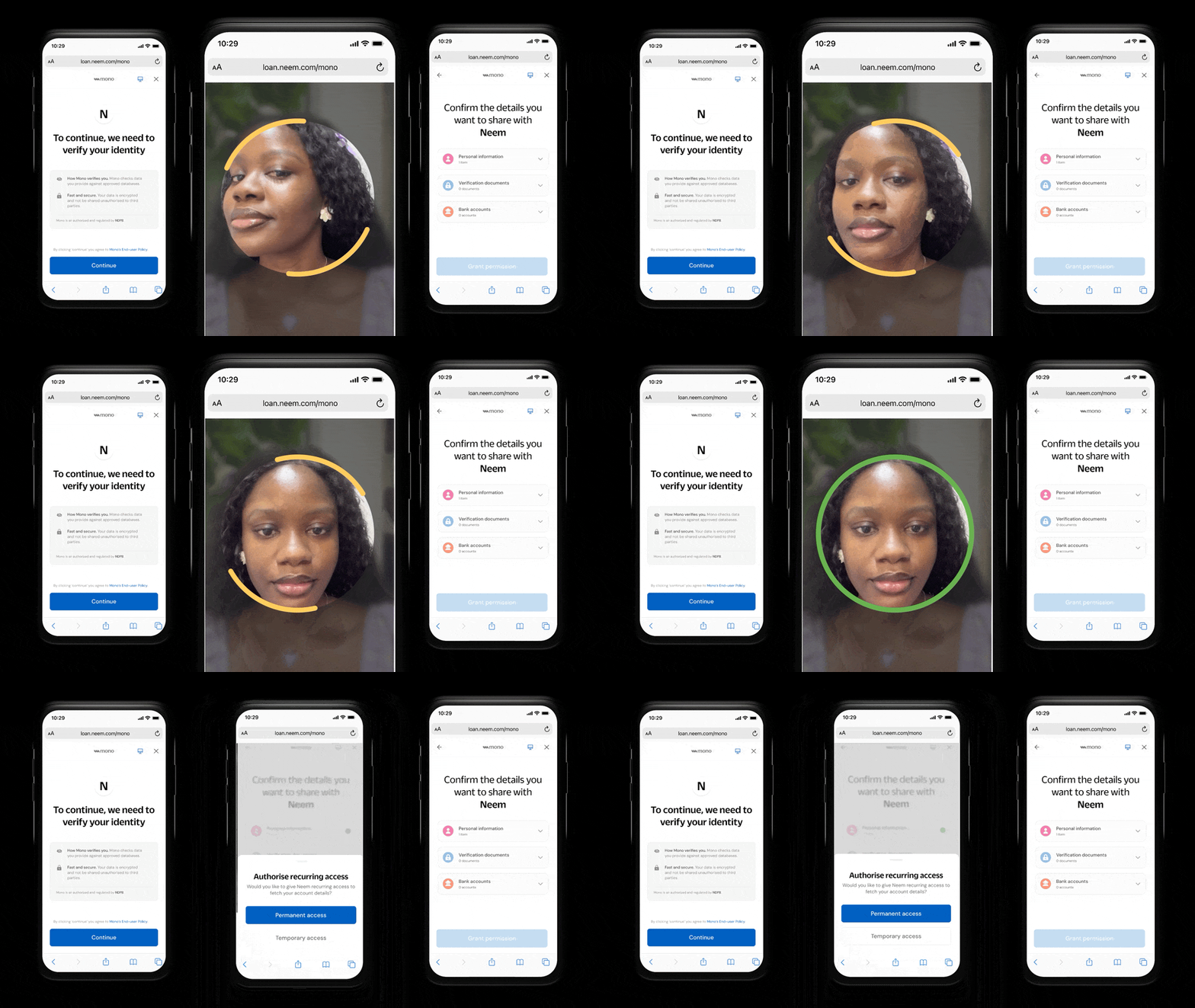
Prove handles three verification requirements that every digital service must address: confirming the user is who they claim to be, confirming they are a real person in real time, and doing both in a way that complies with regulations.
Prove also minimises friction even in setup and verification initiation for businesses. With the pre-set verification tiers that match CBN's three-tiered KYC verification requirements, your developers save time by selecting tiers rather than curating them from scratch, ensuring your business can stay compliant and build smarter onboarding experiences more efficiently.
Prove verifications start with government-issued ID verification. Users photograph their ID from their device, the system extracts data, validates security features, and confirms the ID is authentic and not expired. This handles the first requirement: identity.
Liveness detection runs in parallel. The system analyzes facial movement, eye contact, and behavioural patterns to confirm a real person is behind the camera, not a photo, video, or deepfake. This handles the second requirement: genuine presence.
With each user's consent, all of this data can be tokenized and stored securely within the Prove ecosystem. When the same user returns to another platform using Prove, they are able to reuse their already verified identity details. The system recognises the existing verification, confirms it meets that platform's security requirements, and completes the process in seconds. No document resubmission, no repeated liveness check. For businesses with different compliance and regulatory requirements using Prove, this creates genuine differentiation. For example, a lending platform requiring the highest assurance can demand a full re-verification or a recent one. Another platform or less-regulated service can accept earlier verifications if the user's risk profile supports it. The system gives each business granular control while eliminating the redundant friction of the old model.
The Mono Prove Network
Mono Prove's network-based system creates space for innovation in verification itself. Millions of users and bank connections go through Mono Connect monthly, and we saw the value in building a customer onboarding product with a network effect angle, one where businesses that already trust Mono can benefit from the amount of verified and customer-permissioned data within our ecosystem. With businesses already using Prove and sharing feedback, and as more businesses join the network, the system learns patterns across verifications; liveness detection improves, fraud detection becomes more sophisticated, and compliance requirements can be met with higher certainty in less time. These improvements compound across the entire network, benefiting every participant.
How to get started with Prove
If you're an existing Mono user, simply log into your Mono Dashboard, navigate to the Products section and click "Request access" under Prove. You can also get started with the Mono Prove API guide on our documentation.
If you've never used Mono before, this is a great time to start. Click here to sign up and get started.
Want to learn more about Prove and see the product in action?
Join our CEO, Abdul Hassan, and the Product team for a Q&A webinar session on Monday, the 8th of December, 2025. In this session, Abdul will share our vision for Prove, the ways that it can supercharge the customer onboarding experience within your product and bring your customers to value faster. Register here to save your seat for the session.
Questions you may have and answers to them
What happens if any information on a user's identity changes, or they want to verify again with Prove?
Users can request re-verification at any time on Prove. Businesses can require fresh verification based on their risk assessment. If a user wants to delete their tokenized identity, they can do so, and the data is removed from the network.
Is tokenized verification less secure than traditional identity verification?
Tokenized verification is more secure because it reduces the number of times sensitive identity data is transmitted and stored. Rather than a user submitting documents to five different services, they submit once, and the network confirms that submission to subsequent platforms. Each platform doesn't store duplicate identity documents. The central tokenization reduces exposure and improves audit trails.
Who owns the tokenized identity data?
The user owns their identity data. Businesses have access rights to verify against stored tokens, but they cannot export or sell that data. The data exists in the Mono Prove system and is only used for identity verification within the network. Users can request deletion at any time, which removes their token and associated data.
Is Mono Prove secure?
Yes, Mono Prove is secure. All identity data is fully encrypted in transit and at rest. We maintain all security audits and compliance certifications. We also ensure that all businesses that request to verify customers' identity using Prove are fully reviewed and compliant with regulatory standards and requirements.
What if a user is verified through Prove but then tries to commit fraud on a platform?
Verification confirms identity authenticity. It doesn't stop fraud that happens after identity verification. A user can verify successfully and then engage in fraudulent activity (like using a verified identity to open accounts for money laundering). Businesses using Prove still need fraud and transaction monitoring, and can blacklist fraudulent customers to flag their activity and protect the Prove network.
<iframe width="560" height="315" src="https://www.youtube.com/embed/Tw-71fkiyMA?si=I7HDF9k0Zf79X69R" title="YouTube video player" frameborder="0" allow="accelerometer; autoplay; clipboard-write; encrypted-media; gyroscope; picture-in-picture; web-share" referrerpolicy="strict-origin-when-cross-origin" allowfullscreen></iframe>